
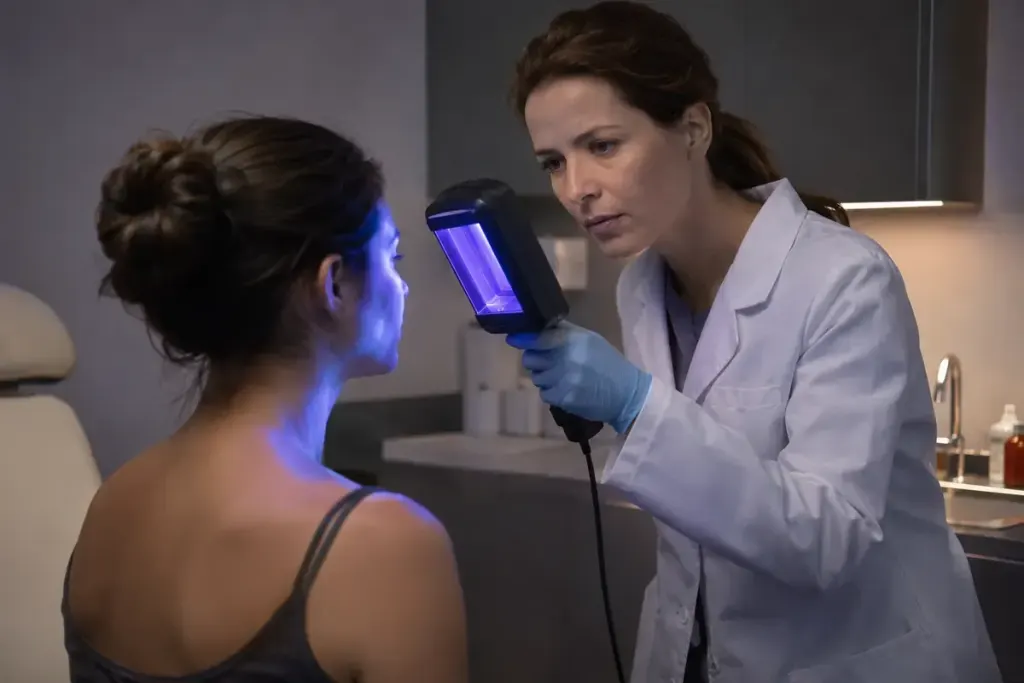
A clinician may darken the room and bring a lamp close to an area of skin. A Wood’s lamp examination uses ultraviolet light to help reveal certain features that can be less obvious under ordinary lighting.
DermNet’s clinical explanation describes its use in assessing some pigment changes and superficial infections. Certain substances or organisms fluoresce, while other changes become easier to see through contrast. The result is one part of an examination, not a universal skin-disease detector.
Three questions worth asking
What question is this test helping answer? The clinician may be looking at the distribution of pigment or investigating a particular possibility. Knowing the purpose helps you understand why a result matters.
Should I avoid products beforehand? Cosmetics, creams and other residues can affect what is seen. Ask the clinic for preparation instructions and tell the clinician what you have applied. Do not stop prescribed treatment unless advised.
What happens if the result is unclear? Some conditions do not fluoresce, and a visible colour alone may not settle the diagnosis. The clinician may need the history, another examination or a different test.
For example, a person could bring a short note of when a patch first appeared and whether it has changed, together with the names of products used on it. That gives the examination a useful context without trying to predict the result from photographs online.
A household ultraviolet torch is not a replacement for a clinical assessment. Differences in the light, skin preparation and interpretation can make comparisons misleading, and unnecessary exposure should be avoided.
After the appointment, write down the explanation and any agreed follow-up. If a skin change is persistent, painful or changing quickly, seek appropriate medical advice rather than relying on whether it appears to glow under a lamp.