
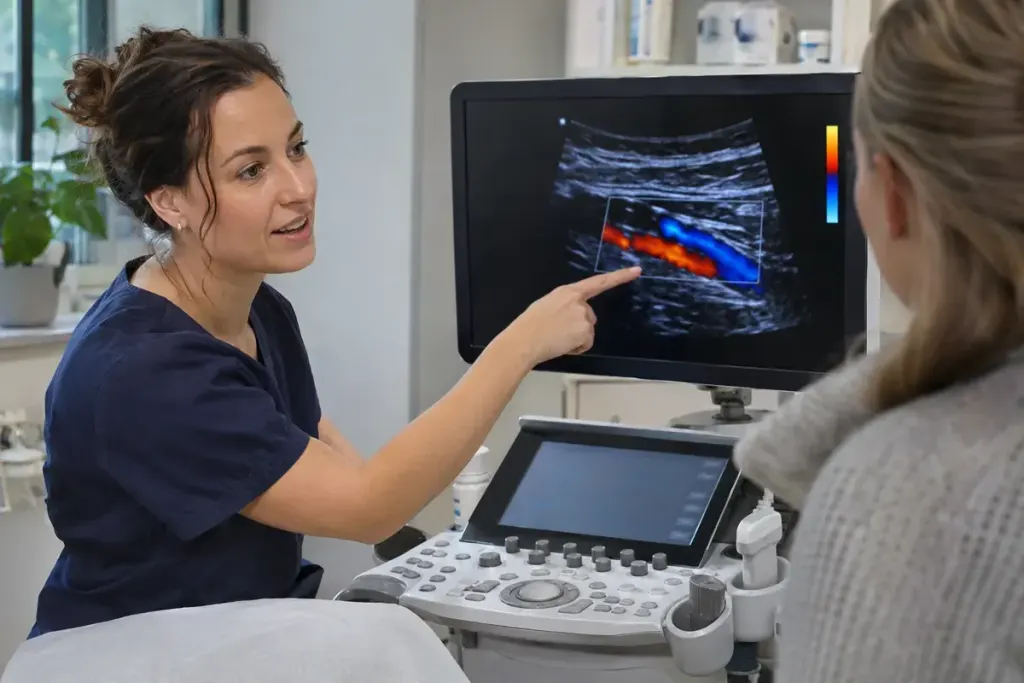
A splash of red and blue on an ultrasound screen can look like a map of oxygen-rich and oxygen-poor blood. That is not what the colours automatically mean. Colour Doppler uses measured motion to display information about flow; the colours belong to the imaging system’s chosen map.
RadiologyInfo, produced by radiology professional organisations, explains that colour Doppler represents blood-flow speed and direction. It also distinguishes power Doppler, which can show weaker flow but does not provide the same directional information, from spectral Doppler, which displays measurements as a graph.
The colour scale is part of the image
Direction is described relative to the ultrasound beam and probe, not simply as “good blood” or “bad blood”. The operator’s settings and the scale displayed beside the image matter. For example, the SonoSite iViz user guide describes a usual red-towards and blue-away display that can be reversed. A cropped screenshot without that information can be especially misleading.
For example, two saved views of the same region may look different because the probe position or settings changed. A patient comparing colours alone could mistake a technical difference for a change in health.
Ask what question the examination answers
Useful questions are: which vessel or structure was assessed, what did the examination show, and what happens next? The person performing the scan may need to complete measurements and have the study interpreted before a result can be discussed.
Do not assume that more colour means a better result or that a dark area proves a blockage. The clinician interprets the images together with other measurements, anatomy, symptoms and the reason for the test.
Keep the report with the picture
If you receive images, ask how to obtain the written report and who will explain it. Note the date and the examination type so you can share the correct study with another clinician. Avoid uploading identifiable scans to public forums for strangers to diagnose.
The screen is a visualisation of measurements, not a colour-coded verdict. Understanding that distinction can make the appointment less mysterious while leaving the medical interpretation with the professionals who have the complete examination and your clinical history.