
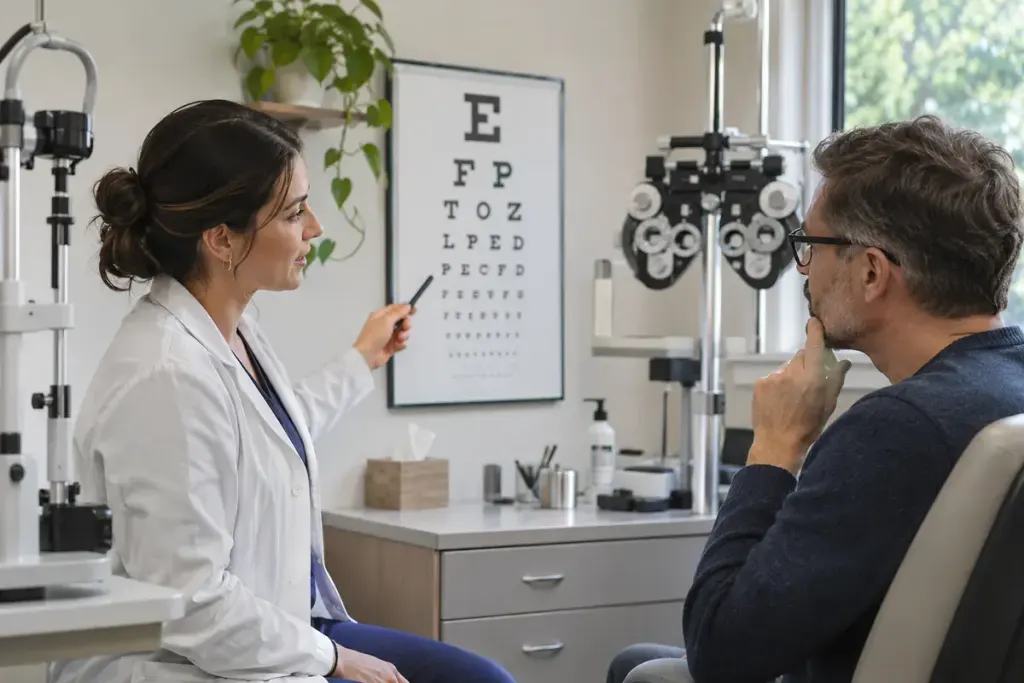
A result of 20/40 can sound like “half-normal vision” when it appears on an eye-test report. That interpretation treats a distance comparison as a percentage. It loses both the meaning of the fraction and the limits of the test.
As the American Academy of Ophthalmology explains, 20/40 means that, at 20 feet, you can see detail that the reference standard can resolve at 40 feet. The numbers compare distances for identifying chart detail. They are not a score for every aspect of seeing.
What belongs beside the result?
Before comparing two reports, find out which eye was tested and whether the measurement was made with glasses or contact lenses, without them, or with the best correction determined during the examination. Those are meaningful differences. A result copied into a message without that context may be difficult for another clinician to interpret.
In an illustrative appointment conversation, a patient might ask: “Is this the result for my right eye with my current glasses, and is that the same test condition as last time?” The question is more useful than trying to convert the fraction into a percentage.
A sharp letter is only one part of seeing
Visual acuity measures the ability to distinguish detail under the test’s conditions. A person can read small letters yet still have difficulties that need discussion, such as glare or problems noticing things to the side. An acuity result alone does not describe the whole visual system or establish the cause of a symptom.
Bring the report and your usual corrective lenses to the appointment, and describe the situations that actually trouble you: reading signs, looking at a screen, or moving between bright and dim spaces. Avoid adjusting a prescription or deciding that an eye is healthy from the fraction alone.
Sudden loss or a sudden major change in vision needs urgent medical assessment. For routine questions, ask the eye-care professional to explain what was measured, what changed and whether any further examination is needed.