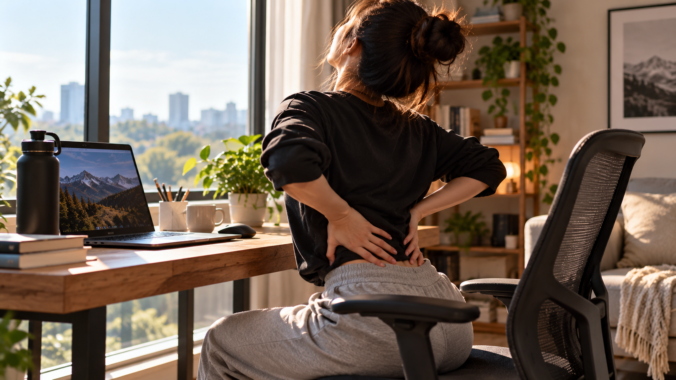
You stand up after working at your desk for a few hours and suddenly feel much older than you did that morning.
Your hips feel tight.
Your lower back needs a moment to straighten.
Your shoulders feel heavy.
Maybe your knees feel strangely stiff during the first few steps.
After walking around for a minute or two, however, much of that discomfort begins to fade.
This experience is extremely familiar to people who spend large parts of the day sitting.
And it creates an interesting question.
Why can the body feel stiff when you have barely been moving?
It seems logical that physical activity would make muscles tired or sore. Sitting, on the other hand, appears to require very little effort.
But the human body is not designed to remain completely still for long periods.
Body stiffness after sitting is often less about having done too much and more about having moved too little.
Understanding why this happens can help you build healthier movement habits without turning every workday into a complicated exercise program.
Sitting Is Restful, but Remaining Still Is Different
Sitting itself is not inherently harmful.
People need rest.
We sit to work, eat, travel, socialize, read, recover, and relax.
The problem is usually not the existence of sitting.
It is duration.
When the body remains in roughly the same position for a long time, certain muscles stay shortened while others remain relatively inactive. Joints repeatedly experience the same position, and normal movement variation disappears.
Eventually, standing up asks those tissues to move through ranges they have not used for a while.
That transition can feel stiff.
Your Body Likes Movement Variety
Human movement is naturally varied.
We walk.
Reach.
Turn.
Bend.
Stand.
Sit.
Squat.
Change direction.
Shift weight.
Even small movements create variation in how muscles and joints are loaded.
A long desk session removes much of that variety.
Your hips remain flexed.
Your knees remain bent.
Your arms stay in front of you.
Your head may drift toward the screen.
Your shoulders may gradually round.
None of these positions is automatically dangerous.
The issue is staying there continuously.
There Is No Magical “Perfect Posture”
Posture is often discussed as though there is one ideal position everyone should maintain all day.
Sit perfectly upright.
Pull your shoulders back.
Keep your spine completely straight.
Never slouch.
Real bodies do not work that way.
Even a technically excellent sitting position can become uncomfortable if maintained for hours without change.
A useful principle is that your next posture can sometimes matter more than your perfect posture.
Change positions.
Move occasionally.
Let different muscles participate.
Why the First Few Steps Can Feel Awkward
After prolonged sitting, standing requires a rapid change in position.
Your hips move from flexion toward extension.
Your knees straighten.
Your ankles begin moving through walking mechanics.
Your trunk becomes responsible for supporting you in an upright position again.
Muscles that were relatively quiet suddenly become active.
That is why the first few steps can sometimes feel noticeably different from how you move after you have been walking for several minutes.
The body is transitioning from stillness back into movement.
Muscles Adapt to the Position You Give Them
Imagine holding your arm in one position for a long time.
Eventually, changing that position may feel uncomfortable.
A similar principle applies during prolonged sitting.
The muscles around your hips, back, shoulders, and neck are spending an extended period in relatively limited positions.
Some are working continuously at low levels.
Others are not being challenged through much range of motion.
When you finally move, the contrast becomes noticeable.
Tightness Does Not Always Mean a Muscle Is Literally “Short”
People often describe stiffness as tight muscles.
That description is useful conversationally, but the sensation of tightness can have multiple contributors.
A muscle may feel tight because of sustained positioning.
It may be fatigued.
Your nervous system may be responding to a position it has maintained for a long time.
Nearby joints may simply need movement.
This is why aggressively stretching every area that feels tight is not always necessary.
Sometimes ordinary movement is enough.
Your Hips Spend Hours in a Flexed Position
Desk sitting keeps the hips bent for long periods.
When you stand, the hips need to extend again.
If you have been sitting for several hours, that transition may initially feel restricted.
You may notice it at the front of the hips.
You might also compensate by changing the position of your pelvis or lower back.
A short walk often begins restoring movement naturally.
The Lower Back Can Feel the Effects Too
Lower-back discomfort is one of the most common complaints associated with prolonged desk work.
But sitting does not affect every person identically.
Some people become uncomfortable when slouching.
Others become uncomfortable trying to maintain an exaggerated upright posture.
Some tolerate sitting well but struggle primarily because they rarely change positions.
Instead of obsessing over one universally correct posture, pay attention to duration and variation.
Your Shoulders May Slowly Drift Forward
Many modern tasks happen directly in front of us.
Laptop work.
Phones.
Writing.
Driving.
Gaming.
Reading.
As attention becomes focused on the task, the shoulders may gradually move forward and the upper back may round.
Again, temporarily adopting this position is normal.
Remaining there for hours can make the opposite movements feel less familiar.
Your Neck Is Often Working Harder Than You Think
A screen placed too low or too far away can encourage the head to move forward.
The change may be subtle.
But the muscles supporting the head still have work to do.
If you spend several hours concentrating on a screen, you may eventually notice tension around the neck and upper shoulders.
Moving your head gently through comfortable ranges and changing your work position can help restore variety.
Phones Add Another Layer of Stillness
Computer work is not always the only sedentary period.
You finish working.
Then sit on the couch.
Then use your phone.
Then watch television.
A person may technically leave the desk while still spending most of the evening in another seated position.
This is why total daily movement matters.
A single workout does not necessarily change how many consecutive hours you spend relatively still.
Exercise and Daily Movement Are Not Exactly the Same Thing
Someone can exercise regularly and still spend most of the day sedentary.
Imagine exercising for forty-five minutes in the morning.
That is valuable physical activity.
But then you sit:
During breakfast.
During the commute.
For several hours at work.
During lunch.
For several more hours.
During the drive home.
During dinner.
During television.
The workout matters, but so does everything happening during the rest of the day.
Small Movements Count
Movement does not always need to look like exercise.
Standing while taking a phone call is movement.
Walking to refill your water is movement.
Changing sitting positions is movement.
Walking across the office is movement.
Taking the stairs is movement.
Doing a few gentle shoulder circles is movement.
The body benefits from variation, and variation can happen in very small doses.
Why Walking Often Makes Stiffness Feel Better
Walking asks many areas of the body to move rhythmically.
Your hips alternate between positions.
Your knees bend and straighten.
Your ankles move.
Your arms naturally swing.
Your trunk subtly rotates.
Muscles repeatedly contract and relax.
Instead of isolating one stiff area, walking introduces coordinated movement across much of the body.
That is one reason a brief walk can feel surprisingly effective after prolonged sitting.
Movement Supports Circulation
Muscular activity contributes to blood flow.
When you walk, the repeated contraction of muscles—particularly in the legs—helps support circulation.
This is one reason movement breaks can feel refreshing beyond simply changing joint positions.
You are shifting from a relatively static state into an active one.
The body generally responds differently when muscles begin working again.
You Do Not Need an Hour-Long Break
People sometimes reject movement advice because it sounds unrealistic.
“I cannot leave my desk every hour and exercise.”
Fortunately, a movement break does not need to become a workout.
Even a short interruption can change your position.
Stand.
Walk briefly.
Stretch comfortably.
Get water.
Use the restroom.
Look away from the screen.
Then return to work.
The objective is not maximizing calories burned.
It is breaking long periods of uninterrupted stillness.
Frequent Small Breaks May Be Easier Than One Big Break
Suppose you sit continuously for four hours and then take a twenty-minute walk.
That walk is useful.
But another strategy is introducing several small periods of movement throughout those four hours.
This can be easier to integrate into a normal workday.
You do not necessarily need to choose between productivity and movement.
Movement can become part of how you transition between tasks.
Use Natural Work Transitions
You do not always need a timer.
Connect movement to things already happening.
After finishing a meeting, stand.
After completing a task, walk to get water.
When you take a phone call, change position.
Before beginning another long work block, move for a minute.
After lunch, walk briefly before sitting again.
These environmental cues can make movement easier to remember.
Hydration Can Create a Useful Movement Loop
Keeping water nearby is convenient.
But occasionally getting up to refill it creates a natural reason to leave your chair.
Drinking fluids also means you will eventually need another break.
This creates a simple cycle:
Drink.
Work.
Stand.
Walk.
Refill.
Return.
The movement may be small, but repeated small movements accumulate across the day.
Your Workspace Can Either Encourage or Discourage Movement
Convenience has advantages.
But extreme convenience can remove nearly every reason to move.
Everything is within arm’s reach.
Water bottle.
Printer.
Snacks.
Phone.
Headphones.
Charging cables.
Documents.
You can remain seated for hours without needing to stand.
Consider whether your workspace could include a few natural reasons to change position.
A Standing Desk Is Not a Complete Solution
Standing desks can provide useful position variety.
But standing completely still for hours can also become uncomfortable.
Replacing eight hours of sitting with eight hours of rigid standing misses the larger principle.
The goal is movement variation.
Sit sometimes.
Stand sometimes.
Walk sometimes.
Change positions.
A standing desk is a tool, not a cure for stillness.
Alternate Rather Than Endure
If standing begins to feel uncomfortable, sit.
If sitting begins to feel uncomfortable, stand.
If both feel stale, walk.
You do not receive extra health points for enduring a position until it hurts.
The purpose of an adjustable workspace is flexibility.
Use the flexibility.
Chair Setup Still Matters
Movement variation does not mean ergonomics are irrelevant.
A poorly arranged workstation can make prolonged work more uncomfortable.
A chair should generally allow you to sit without constantly fighting for support.
Your feet should have a stable surface.
Frequently used items should be accessible without awkward repetitive reaching.
Your screen should be positioned so you can view it comfortably.
But remember:
Even an excellent ergonomic setup does not eliminate the need to move.
Your Screen Position Can Influence Your Whole Upper Body
If the screen is difficult to see, the body adapts.
You lean forward.
Your head moves closer.
Your shoulders follow.
You may remain there without noticing.
Rather than repeatedly telling yourself to “sit straight,” make the task easier for your body.
Adjust screen distance.
Improve text size if necessary.
Use appropriate lighting.
A comfortable visual setup can reduce the temptation to creep toward the monitor.
Laptop Users Face a Particular Compromise
A laptop combines the screen and keyboard.
That portability is useful.
But when the keyboard is positioned comfortably for the hands, the screen may sit relatively low.
Raise the laptop and the keyboard becomes less convenient.
For long desk sessions, an external keyboard or monitor can provide more flexibility.
For short sessions, simply changing positions frequently may be enough.
Do Not Turn Posture Into a Source of Anxiety
Constantly monitoring whether every joint is perfectly aligned can become exhausting.
Your body is not fragile because you slouched for ten minutes.
People naturally use many postures throughout the day.
Instead of fearing “bad posture,” focus on avoiding excessive sameness.
Comfortable variation is usually a more realistic goal.
Stretching Can Feel Good, but It Is Not the Only Tool
After sitting, stretching may provide relief.
A gentle hip stretch.
A chest-opening movement.
A comfortable upper-back rotation.
Calf movement.
Neck mobility.
These can all feel pleasant.
But you do not necessarily need a complicated stretching routine.
Sometimes walking around for several minutes provides the movement your body was asking for.
Avoid Forcing a Stretch Through Pain
Stretching should not become a competition.
More intense does not automatically mean more effective.
If a movement produces sharp pain, numbness, tingling, or another unusual symptom, forcing deeper into the position is not a sensible strategy.
Gentle movement should generally feel controlled.
Pain is not proof that a stretch is “working.”
Strength Matters Too
Mobility receives much of the attention when discussing stiffness.
But strength is also relevant to comfortable movement.
Muscles help support joints and maintain positions.
A body that regularly experiences different forms of resistance may tolerate everyday tasks differently from one that rarely does.
Strength training does not need to be extreme.
The appropriate level depends on the individual.
Your Glutes Spend a Lot of Time Relatively Quiet
During walking, climbing stairs, running, and many lower-body exercises, the gluteal muscles contribute to movement.
During sitting, they are not being used in the same way.
After long periods at a desk, standing and walking reintroduce those muscles to active movement.
Regular lower-body activity can help maintain capacity for tasks that sitting simply does not provide.
The Upper Back Benefits From Movement Variety
Desk tasks often involve relatively little upper-back movement.
Adding gentle rotation and reaching throughout the day can provide contrast.
Turn to look behind you.
Reach overhead comfortably.
Move your arms through different directions.
Walk while allowing your arms to swing naturally.
Simple movements can remind the body that it has more options than the desk position.
Your Ankles Can Become Forgotten at a Desk
When sitting, ankles may remain relatively still.
But they are important during walking, stair climbing, balance, and many exercises.
Occasionally moving the ankles through comfortable ranges can be useful.
Even standing up automatically asks more from the feet and ankles than remaining in a chair.
The entire lower body participates when you return to movement.
Long Meetings Can Be Especially Challenging
A two-hour meeting can create uninterrupted sitting even for someone who normally moves frequently.
When appropriate, consider whether every meeting needs to be seated.
A short one-on-one discussion might work as a walking meeting.
Remote meetings may allow you to stand for part of the conversation.
Even simply changing position halfway through can introduce variation.
Commuting Adds Hidden Sitting Time
A desk worker may calculate eight hours of sitting at work.
But the real number can be higher.
Thirty minutes driving to work.
Thirty minutes home.
Time eating meals.
Time relaxing afterward.
Long-distance commuters may accumulate substantial sedentary time before the workday is even counted.
This is another reason to look at the whole day rather than only office hours.
Travel Can Make Stiffness More Noticeable
Flights, long drives, buses, and trains can keep you in restricted positions for extended periods.
The environment also limits your movement options.
When possible and safe, take reasonable opportunities to stand and move.
During road trips, stops can provide movement breaks.
During flights, follow safety instructions and move when permitted.
Travel is one of the clearest examples of how prolonged stillness can make the body crave movement.
Stress Can Influence How the Body Feels
Physical stiffness does not exist completely separately from mental state.
During stressful work, people may unconsciously tense muscles.
The shoulders rise.
The jaw tightens.
Breathing becomes shallow.
The body remains braced while attention stays fixed on the task.
Hours later, you may interpret the result entirely as a posture problem.
Sometimes the work environment itself is contributing.
Notice Whether You Are Bracing
While reading this, check your body.
Are your shoulders unnecessarily elevated?
Are you clenching your jaw?
Are you gripping the mouse harder than necessary?
Are your hands tense?
Are you holding your breath?
You do not need to force yourself into complete relaxation.
Simply noticing unnecessary tension can help you let some of it go.
Breathing Can Become Shallow During Concentration
People sometimes breathe differently when intensely focused.
Long periods of shallow breathing combined with muscular tension can contribute to an overall sense of physical strain.
Occasionally changing position and taking a few comfortable breaths can act as a reset.
This is not a special breathing technique.
It is simply a reminder that work should not require your entire body to remain braced.
Fatigue Can Make Stiffness Feel Worse
At the beginning of the day, your sitting position may feel fine.
By late afternoon, the same chair can feel much less comfortable.
Part of this may relate to accumulated time in similar positions.
Part may involve general fatigue.
This is why relying entirely on posture correction late in the day may not solve the problem.
Your body may simply need a change of activity.
The Weekend Can Reveal Your Weekday Pattern
Pay attention to whether stiffness changes on days when your routine is different.
Perhaps you walk more on weekends.
Spend time outside.
Do household tasks.
Shop.
Visit people.
Move between locations.
If your body consistently feels different on those days, your weekday movement pattern may be worth examining.
The comparison can provide useful information about your habits.
Do Not Wait Until You Feel Extremely Stiff
Movement breaks work better as routine than as emergency response.
If you wait until your back feels terrible before standing, you have already spent a long time in one position.
Try moving before discomfort becomes the reminder.
That may mean changing position at natural intervals rather than responding only after symptoms become obvious.
Make Movement Convenient
Habits are easier when the environment supports them.
Keep comfortable shoes available if necessary.
Choose stairs when practical.
Place water somewhere that occasionally requires standing.
Take brief walks during suitable phone calls.
Use a printer slightly farther away.
Park where a short walk is reasonable.
None of these actions is dramatic.
That is exactly why they can be sustainable.
Avoid Creating an Unrealistic Routine
A wellness plan can fail because it asks too much.
Twenty stretches every hour.
A long morning mobility routine.
A full workout at lunch.
Another routine before bed.
Most people will not maintain that indefinitely.
Start with something smaller.
A few movement breaks.
A short walk.
More position changes.
Then build from there if it helps.
Consistency Matters More Than the Perfect Mobility Routine
The internet contains countless mobility exercises.
Many are useful.
But constantly searching for the perfect routine can distract from the simplest behavior:
Move regularly.
You do not necessarily need advanced exercises to interrupt prolonged sitting.
Basic human movement is already valuable.
Walk.
Stand.
Reach.
Turn.
Bend comfortably.
Change positions.
Repeat tomorrow.
Use Your Body’s Feedback
Not everyone responds identically to the same routine.
One person may feel better after frequent short walks.
Another may benefit from alternating sitting and standing.
Someone else may need to change their workstation.
Another person may discover that a specific exercise program improves how they feel.
Observe patterns rather than assuming one universal solution.
Track When Stiffness Appears
If body stiffness after sitting happens regularly, pay attention to timing.
Does it appear after thirty minutes?
Two hours?
Only late in the day?
Mostly after driving?
Mostly when using a laptop?
Mostly after sitting on a particular chair?
Does walking improve it?
Does it persist despite movement?
These details can help distinguish a general movement habit from a more specific issue worth investigating.
Not Every Stiff Feeling Should Be Blamed on Sitting
This point matters.
Prolonged sitting can contribute to ordinary stiffness, but not every symptom has the same explanation.
Persistent pain can have many possible causes.
Joint problems, injuries, nerve irritation, inflammatory conditions, and other health issues can produce symptoms that should not simply be dismissed as “I sat too long.”
Context matters.
Pay Attention to Symptoms That Behave Differently
Ordinary stiffness after sitting often improves once you begin moving.
But if discomfort is severe, persistent, worsening, or accompanied by other concerning symptoms, it deserves more attention.
For example, symptoms such as significant weakness, persistent numbness or tingling, unexplained swelling, a recent significant injury, or problems with normal daily function should not simply be treated with endless stretching.
A qualified healthcare professional can evaluate symptoms in the context of your individual health history.
Sudden Leg Symptoms Require Particular Caution
Prolonged immobility can be relevant to blood clot risk in some situations, particularly during long travel and in people with additional risk factors.
Sudden one-sided leg swelling, significant pain or tenderness, warmth, or discoloration should not be casually attributed to ordinary stiffness.
Chest pain, difficulty breathing, coughing up blood, fainting, or similar acute symptoms can require urgent medical attention.
Wellness advice should never replace appropriate medical evaluation when symptoms suggest something more serious.
The Goal Is Not to Become Afraid of Sitting
Sitting is part of normal life.
You do not need to stand through every meal.
You do not need to pace around while watching a movie.
You do not need to feel guilty every time you relax on the couch.
The healthier perspective is simpler.
Your body appreciates movement variety.
Enjoy sitting.
Just remember to move too.
Think About Your Day as a Movement Budget
Instead of asking only:
“Did I exercise today?”
Try asking:
“How much did I move throughout the day?”
A workout can be part of that answer.
So can walking.
Household tasks.
Stairs.
Standing.
Shopping.
Gardening.
Playing with children.
Walking a dog.
Movement exists beyond formal exercise.
Break Up the Longest Periods First
You do not need to redesign your entire life.
Look for the longest uninterrupted sitting period.
Maybe it is your morning work block.
Maybe it is a three-hour gaming session.
Maybe it is your commute followed immediately by desk work.
Maybe it is evening television.
Start there.
Breaking one long sedentary block may be more realistic than trying to optimize every minute of the day.
Build Movement Into Things You Already Do
Habit change becomes easier when it attaches to existing routines.
After coffee, walk briefly.
After lunch, move.
After a meeting, stand.
When a television episode ends, get up.
When you finish a gaming match, move around before starting another.
When you complete a work block, leave the chair.
You are not creating dozens of new appointments.
You are attaching movement to moments that already exist.
Comfortable Movement Should Become Normal Again
The ultimate goal is not to spend your life performing corrective exercises.
It is to maintain a lifestyle in which your body regularly experiences movement.
Walking should not be an unusual event.
Standing should not feel like a workout.
Reaching, bending, and changing positions should remain ordinary parts of daily life.
The more varied your routine, the less dependent you may become on one perfect chair or one perfect posture.
Conclusion
Body stiffness after sitting can feel strange because sitting seems like rest.
But rest and prolonged stillness are not the same thing.
When you remain in one position for hours, your hips, knees, back, shoulders, neck, and other areas experience very little movement variation. Some muscles remain active in similar ways while others contribute relatively little. Then, when you finally stand, the body must transition back into a much broader pattern of movement.
That is why the first few steps may feel stiff while walking around often makes things feel easier.
The solution does not need to involve complicated mobility routines or constant anxiety about perfect posture.
Start with movement variety.
Change positions.
Stand periodically.
Walk when practical.
Adjust your workspace so it supports comfortable movement rather than forcing one rigid posture.
Exercise regularly according to your abilities, but also pay attention to the many hours outside your workout.
Most importantly, learn the difference between ordinary temporary stiffness and symptoms that persist, worsen, or suggest something beyond a sedentary routine.
Your body was not designed to remain frozen in one position all day.
Sometimes the most useful response to stiffness is surprisingly simple:
Give it another position to experience.